
Wednesday, 30 November 2011
"One day a free India will appear in the world" Joint Statement of Proletarian Party of East Bengal (Maoist Unity Group/ Bangladesh and Communist Party Marxist Leninist Maoist (France)

November 28, 2011
Proletarian Party of East Bengal (Maoist Unity Group)/Bangladesh
Communist Party Marxist Leninist Maoist (France)
“One day a free India will appear in the world!”
It is with deep sadness that we learnt the brutal killing of Comrade Koteshwar Rao alias Kishenji in the Jangalmahal region of West Bengal, in India.
This murder hurts us in our minds, in our flesh. Because we are communists, because India is a big country, where an important part of the world masses are living. Numerous are the contributions of the Indian culture to the history of the world, and this will continue.
India's importance can not be stressed enough; as Mao Zedong did it himself:
« One day a free India will appear in the world as a member of the great family of socialism and People's Democracies, just as free as China has.
That day shall end the epoch of imperialism and reaction in the history of humanity. »
(Mao Zedong, Telegram to the Communist Party of India, november 19, 1949, to B.T. Ranadive, general secretary of the Communist Party of India, signed by Mao Zedong and dated).

Monday, 28 November 2011
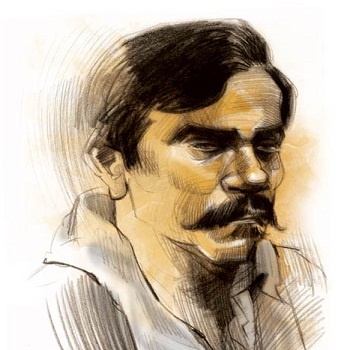
from Nepal: “Red Salute ! to our Beloved Comrade Kishanj

from Nepal: “Red Salute ! to our Beloved Comrade Kishanji”
Comrade Kishanji
It is a matter of deep sorrow that the reactionary Indian government has murdered Comrade Kishanji alias Malloujula Koteswara Rao, Politburo Member of CPI (Maoist), in a fake incounter in Burishol forest area, west Midnapore District, Jangalmahal, West Bengal on 24 November 2011. He was a leading figure and spokesperson for CPI (Maoist) . According CPI (Maoist) statement issued to the media, Kishanji was arrested and tortured and then brutally killed.
Varavara Rao holds Mamata Banerjee responsible for the torture and death of Kishanji

Picture Mamata Banerjee
Telugu Poet P Varavara Rao on Saturday said slain leader Kishenji was killed in a 'staged encounter' and held West Bengal chief minister Mamata Banerjee responsible for the death.
"I have seen him (Kishenji) several times since 1991. During the last 43 years I have seen a lot of dead bodies but none like this.
They cut him, burnt him, then pumped bullets into him.
They cut him, burnt him, then pumped bullets into him.
"There isn't a single part of his body without an injury.
They kept him in custody for 24 hours and tortured him," said Rao, who along with Kishenji's niece Deepa Rao has come here to identify and take back the rebel leader's body back to his native place in Andhra Pradesh.
They kept him in custody for 24 hours and tortured him," said Rao, who along with Kishenji's niece Deepa Rao has come here to identify and take back the rebel leader's body back to his native place in Andhra Pradesh.
Rao held Banerjee responsible for killing Kishenji.
"Mamata (Banerjee) has killed Kishenji who had asked her for peace," Rao told reporters.
Saturday, 26 November 2011
Death of Comrade Kishanji - Peddapally plunged into mourning

- A pall of gloom has descended over Peddapally in Karimnagar district on hearing about the death of the senior CPI Maoist leader Mallojula Koteshwara Rao alias Kishenji as the people recalled the memories of his childhood and youth.
Kishanji's mother Madhuramma has been crying uncontrollably ever since she heard the news of the death of her son in an alleged encounter in West Bengal yesterday. The other family members including his younger brother Anjaneyalu, a cooperative bank employee, were the picture of mourning.
While many locals including some of Kishanji's childhood friends openly praised him as a ‘beacon of hope for the poor' and ‘a revolutionary who fought against injustice', Anjaneyalu demanded that his body be handed over to the family so they could perform the last rites in Peddapally.
An inspiration
A large number of people gathered at the residence of Kishenji's brother to express their condolences.
"They have killed him physically but his life will remain an inspiration for the people as long as there is injustice in the society,"
said a middle-aged woman.
"They have killed him physically but his life will remain an inspiration for the people as long as there is injustice in the society,"
said a middle-aged woman.
Meanwhile Kishenji's niece Deepa along with three activists left for Kolkatta this morning to retrieve the body. The group was led by revolutionary poet Vara Vara Rao and included Andhra Pradesh civil liberties committee secretary C Chandrashekhar, Padma Kumari, Secretary, Amarula Bandhu Mitrulu Sangham (Martyrs Relatives and Friends Association).
However Vara Vara Rao was taken into custody by the West Bengal Police as soon as he landed in Kolkatta. Before leaving Hyderabad he condemned Kishernji's killing as a ‘fake encounter' and demanded a judicial inquiry in to the incident.
"We will approach High Court for a fresh post-mortem in Kolkatta and bring the body to his home town Peddapally, Karimnagar district for last rites," said Vara Vara Rao.
At present the body is being kept in the Midnapore hospital mortuary.
"It will take some time to complete the formalities and get the body handed over to the family members", said another activist involved in the efforts.
"This is nothing but a fake encounter, an inhuman act. He was taken into custody by the police during the search operation a day earlier," said Vara Vara Rao.
Press Statement on the cold-blooded murder of Maoist Leader, Kishanji
25/11/2011
We strongly condemn the cold-blooded murder and planned assassination of Kishanji alias Mallojula Koteswara Rao, Politburo Member of CPI (Maoist) in Burishol forest area, Paschim Midnapore District, Jangalmahal, West Bengal on 24 November 2011. At the time of this murder Kishanji was dealing with the process of peace talks through the interlocutors appointed by the Chief Minister of West Bengal Ms. Mamata Banerjee. Such a heinous crime should be condemned by all justice loving people.
Kishenji: An Indian Patriot And Hero For All Times By Trevor Selvam
25 November, 2011
Countercurrents.org
 Kishenji, the Maoist guerilla commander who was killed two days ago by the Joint Forces of the West Bengal Police Force and the Counter Insurgency Force deployed by Mamata Banerjee, organized the working poor of India’s tribal and Adivasi belt for thirty four years. He was there in the mountains, the villages, the forests of India, building mass organizations, organizing village defense forces, setting up a peoples’ militia and then the rudiments of a liberation army amongst the peasantry of that region. Kishenji, an engineering graduate and longtime communist activist, survived with the support of the local villagers and was able to build the Maoist organization by leaps and bounds, for the past decade. The world needs to know about this man.
Death of Comrade Kishanji - All men must die, but death can vary in its significance.

Picture: Mount Tai
All men must die, but death can vary in its significance. The ancient Chinese writer Szuma Chien said,
"Though death befalls all men alike, it may be weightier than Mount Tai or lighter than a feather." To die for the people is weightier than Mount Tai, but to work for the fascists and die for the exploiters and oppressors is lighter than a feather.
Comrade Kishanji died for the people, and his death is indeed weightier than Mount Tai .
Mao Zedong - Serve the People
amended by Democracy and Class Struggle
based on September 8th 1944 article
Losing our brother Kishenji: The state murder of India’s Maoist leader
Posted by kasama on November 25, 2011

Thursday, 24 November 2011
Original Occupation: Native Blood & the Myth of Thanksgiving
http://kasamaproject.org/
Posted by Mike E on November 23, 2011

Corporate attacks on India’s peasants
http://southasiarev.wordpress.com/
Posted by redpines on November 22, 2011

The California Hunger Strike: Repression, Resistance, the US Prison System, and Political Imprisonment in India
http://sanhati.com/By Isaac Ontiveros.
The author works on the media committee of the Prisoner Hunger Strike Solidarity coalition.
An Introduction by Partho Sarathi Ray
The demand for the release of political prisoners is a major demand of democratic movements in India now, and the condition of prisoners in jail a major cause for concern. The case of Binayak Sen had brought the issue of political prisoners into focus, but there are thousands like him languishing in jails, including people like Jiten Marandi who have been sentenced to death.
The situation has parallels to the USA, which has the largest prison population ratio to the total population in the world, and has political prisoners who have been in jail for more than thirty years, from the time when the Black population of the US stood up in struggle for their rights. In the following article, the author Isaac Ontiveros of the Prisoner Hunger Strike Solidarity Condition writes about the recent historic hunger strike by prisoners in California prisons, which had focused attention on the US prison system and the condition of prisoners therein. This hunger strike, which at one point had 12000 participants throughout the California prison system, exposed the inherent repression, maltreatment and misery of the prisoners in the US prisons and became a symbol of resistance against these.
Orissa - Statement protesting against state repression on people’s movement in Narayanpatna
November 23, 2011
On 20 November 2011, we, the undersigned, were heading towards Podapadar village in Narayanpatna block of Koraput district where the Chasi Mulia Adivasi Sangha (CMAS) was to organize a public meeting to pay tribute to the sacrifices made by two of their frontline leaders, Wadeka Singana and Nachika Andrew, who had fallen prey to state terror two years back on the same day. On 20 November 2009, hundreds of ‘unarmed’ adivasis had assembled at the Narayanpatna police station to register their protest democratically against untold excesses committed by police and paramilitary forces on them in the pretext of combing operations. But, the police – in the most undemocratic and barbaric manner – indiscriminately fired at the people in which Wadeka Singana and Nachika Andrew fell dead inside premises of the police station and several were wounded.
Situation in Nepal still exists in favour of revolutionaries: Dilip Maharjan "Bhishma"

UCPN-Maoist is in intense two line struggle. How can you explain it in people’s language for easy understanding?
Certainly, the issues of two line struggle are known to the people. It means two line struggle has reached to the people. The situation and the need demanded to carry the two line struggle among the people. Two-line struggle, in the past, was less concerned to the people because it was more in the level of opinion, ideology and the tactical line of the party. However, today, party leadership is advancing against the decisions of the party one after other. Recently, 4-point agreement, BIPPA agreement, 7-point agreement, dissolution of People’s Liberation Army, returning the land of the landless and homeless to the land lords, confiscation of the rights of the workers and make the local people deprived of their privileges are the activities committed by the party leadership which is against the people, nation and the right of freedom.
Subscribe to:
Posts (Atom)